Anatomy Flashcards
Ready-made anatomy flashcards with a built-in spaced-repetition study system — the major human body systems, the key organs and structures, and the anatomical terms that describe how they relate. Hear each term pronounced, not just spelled. No Anki. Read every card free; one Pro plan opens study with audio on every deck.
All Anatomy flashcard sets
Pick the set that fits your goal. Read every card free; Pro unlocks study with native audio on all of them.
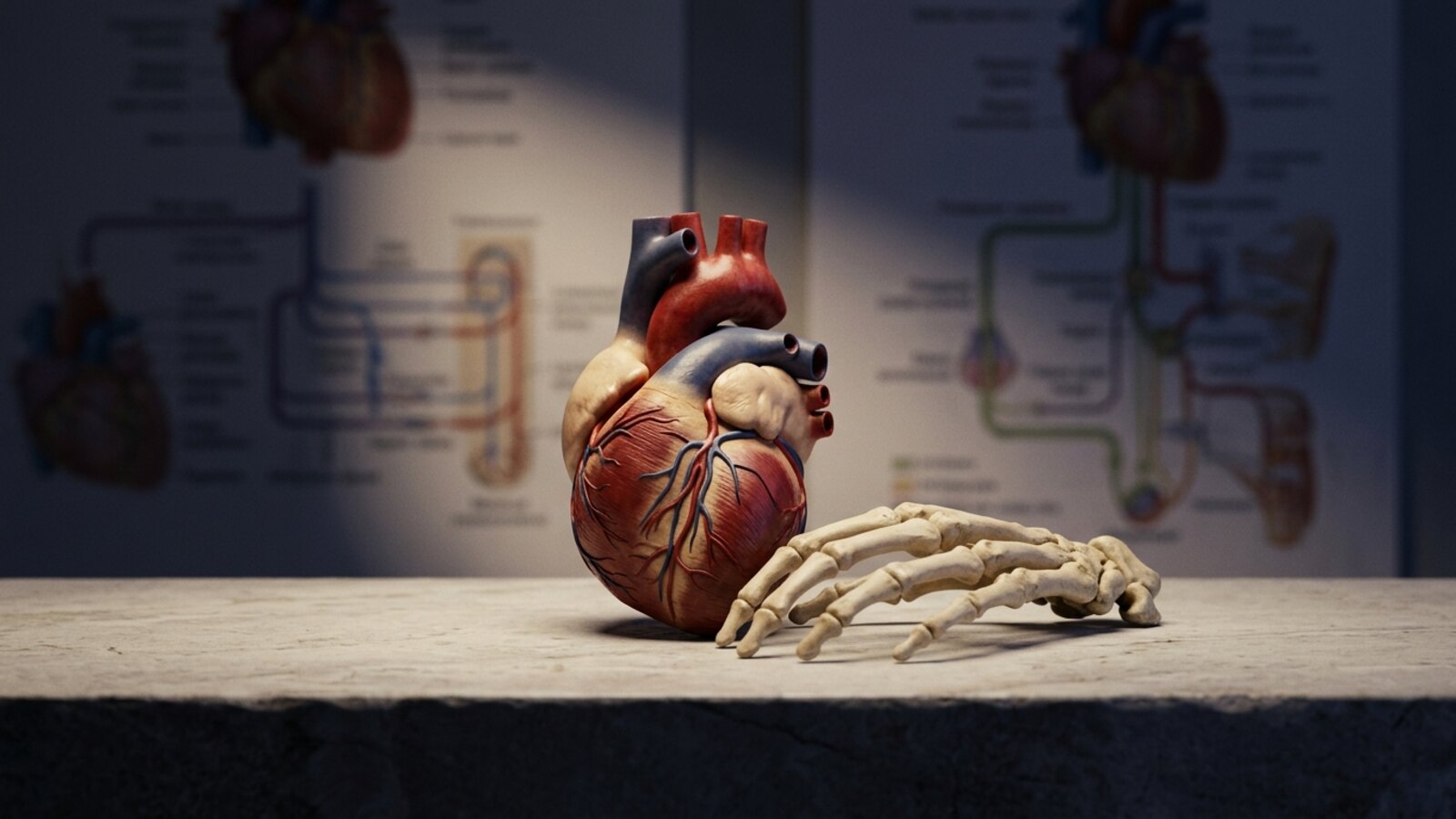
Learn the directional terms before the structures
Anatomy describes every structure by where it sits relative to something else. These pairs appear in almost every definition you will read, so learning them first makes the rest of the vocabulary readable.
| Term | Means | Its opposite | Example |
|---|---|---|---|
| Superior | Toward the head | Inferior (toward the feet) | The heart is superior to the stomach. |
| Anterior | Toward the front | Posterior (toward the back) | The sternum is anterior to the heart. |
| Medial | Toward the midline | Lateral (away from the midline) | The nose is medial to the eyes. |
| Proximal | Nearer the point of attachment | Distal (further from it) | The elbow is proximal to the wrist. |
| Superficial | Nearer the surface | Deep (further in) | Skin is superficial to muscle. |
| Supine | Lying face up | Prone (lying face down) | The patient was placed supine. |
Why anatomy vocabulary is more learnable than it looks
Every one of those terms is relative, which is the point people miss at first. Nothing is simply proximal; it is proximal to something else. All of them assume the anatomical position, the standard reference pose of standing upright, facing forward, palms out. Descriptions stay consistent between a standing patient and one on a table only because that reference is fixed.
The terms also come in opposing pairs, so they are learned two at a time rather than one at a time. That halves the work, and it makes recall easier, because remembering one end of the pair drags the other along with it.
Structure names then stop being arbitrary. Once you know that a term is built from a root, a prefix and a suffix, and that Latin and Greek parts repeat across the whole vocabulary, an unfamiliar structure often decodes without being taught. The same roots that build anatomy build the clinical terms in the medical terminology set, so the two reinforce each other.
Practical order for study: directional terms and planes first, then the systems one at a time rather than in parallel, and structures grouped by the region they sit in. Anatomy studied region by region sticks better than anatomy studied as an alphabetical list, because the surrounding structures give each name something to hang on.
Why these Anatomy flashcards
Native-speaker audio
Hear the correct pronunciation on every card, not just a romanization.
No Anki, no setup
Study right here in your browser or on mobile. Nothing to install or configure.
One plan, every deck
Pro covers every language and subject here and in the iPhone app. Cancel anytime.
Preview the flashcards
A free sample drawn from across the Anatomy sets — hear every card with native audio in the full deck.
- Humerus/ HYOO-muh-rus /
- The long bone in the upper arm, extending from the shoulder to the elbow.
- Clavicle/ KLAV-ih-kul /
- The collarbone; a slender, S-shaped bone that extends from the sternum to the scapula.
- Ligament/ LIG-uh-ment /
- A tough, fibrous connective tissue that connects bones to other bones, providing stability to joints.
- Quadriceps Femoris/ KWOD-rih-seps FEM-or-is /
- A group of four muscles on the front of the thigh that extend the knee.
- Artery/ AR-tuh-ree /
- A blood vessel that carries oxygenated blood away from the heart to the rest of the body (except pulmonary artery).
- Erythrocyte/ eh-RITH-roh-site /
- A red blood cell; responsible for transporting oxygen from the lungs to the body tissues.
- Synapse/ SIN-aps /
- A junction between two nerve cells, consisting of a minute gap across which impulses pass by diffusion of a neurotransmitter.
- Pancreas/ PAN-kree-us /
- A gland located behind the stomach, producing digestive enzymes and hormones like insulin and glucagon.
- Ureter/ YOO-reh-ter /
- A tube that carries urine from the kidney to the urinary bladder.
- Dermis/ DER-mis /
- The layer of skin beneath the epidermis, containing connective tissue, hair follicles, sweat glands, and nerve endings.
- Superior/ soo-PEER-ee-or /
- Toward the head end or upper part of a structure or the body; above.
- Cervical/ SER-vih-kul /
- Relating to the neck, especially the seven vertebrae of the neck (C1-C7).
Frequently asked questions
What is the fastest way to learn anatomy?
Study it by body system rather than as one long list, and use spaced repetition so each term comes back just as you're about to forget it. Grouping structures by the system they belong to gives you a mental map to hang the terms on — which is how this deck is organized.
Do these work for anatomy and physiology (A&P)?
The deck focuses on anatomical terminology — the body systems, organs, structures, and the terms that name and locate them — which is the anatomy half of an A&P course. It's a strong foundation for the terminology you'll need; pair it with your course material for the physiology (function) side.
Do these anatomy flashcards include audio?
Yes. Every card can be played aloud so you can hear how each anatomical term is pronounced, and the built-in spaced-repetition system schedules your reviews. It all runs in your browser and on mobile.
Do I need Anki or a subscription?
No Anki. The deck and the study system run right here. Reading every card is free; study mode with audio is part of SubjectCards Pro, one plan that covers every subject on the site.
Keep learning Anatomy
More free guides and decks to get you speaking.