Musical Instruments Vocabulary and Techniques
50 flashcards · Beginner · Music & Arts
Part of Music Theory Flashcards — compare every set side by side.
Try a sample flashcard
Flip it, then tap the speaker to hear the native audio every card carries.
Flute
Click to flip
A woodwind instrument, usually made of metal, played by blowing across an embouchure hole. It produces a clear, high-pitched sound.
Flute
What you'll learn
- Identify diverse musical instruments.
- Understand various playing techniques.
- Master essential music terminology.
- Describe instrument sounds and roles.
What's inside: all 50 cards
Every card in this set, free to read. Pro adds native audio on each one and a review schedule that brings it back before you forget it.
Woodwinds · 12
- Flute/ FLOOT /
- A woodwind instrument, usually made of metal, played by blowing across an embouchure hole. It produces a clear, high-pitched sound.
- Piccolo/ PIK-uh-loh /
- A small woodwind instrument, essentially a half-size flute, playing an octave higher than the flute. Known for its piercing, brilliant sound.
- Oboe/ OH-boh /
- A woodwind instrument with a double reed, known for its distinctive, reedy sound and often used to tune the orchestra.
- English Horn/ ING-glish HORN /
- Also known as Cor Anglais, it's a double-reed woodwind instrument, larger than the oboe and playing a fifth lower. It has a melancholic, expressive tone.
- Clarinet/ KLAIR-uh-net /
- A single-reed woodwind instrument with a wide range and versatile tone, commonly found in orchestras, bands, and jazz ensembles.
- Bass Clarinet/ BAYS KLAIR-uh-net /
- A large, low-pitched member of the clarinet family, playing an octave lower than the standard B♭ clarinet. It has a deep, resonant sound.
- Bassoon/ buh-SOON /
- A large double-reed woodwind instrument, known for its distinctive U-shaped body and a rich, reedy, somewhat nasal tone.
- Contrabassoon/ KON-truh-buh-SOON /
- The lowest-pitched woodwind instrument, playing an octave below the bassoon. It produces a deep, rumbling sound.
- Alto Saxophone/ AL-toh SAKS-uh-fohn /
- A medium-sized member of the saxophone family, commonly used in jazz, classical, and band music. It has a warm, expressive tone.
- Tenor Saxophone/ TEN-or SAKS-uh-fohn /
- A larger member of the saxophone family, known for its rich, full sound, often featured in jazz and rock music.
- Baritone Saxophone/ BAIR-ih-tohn SAKS-uh-fohn /
- The largest and lowest-pitched common member of the saxophone family, providing a deep, resonant foundation in ensembles.
- Recorder/ ri-KOR-der /
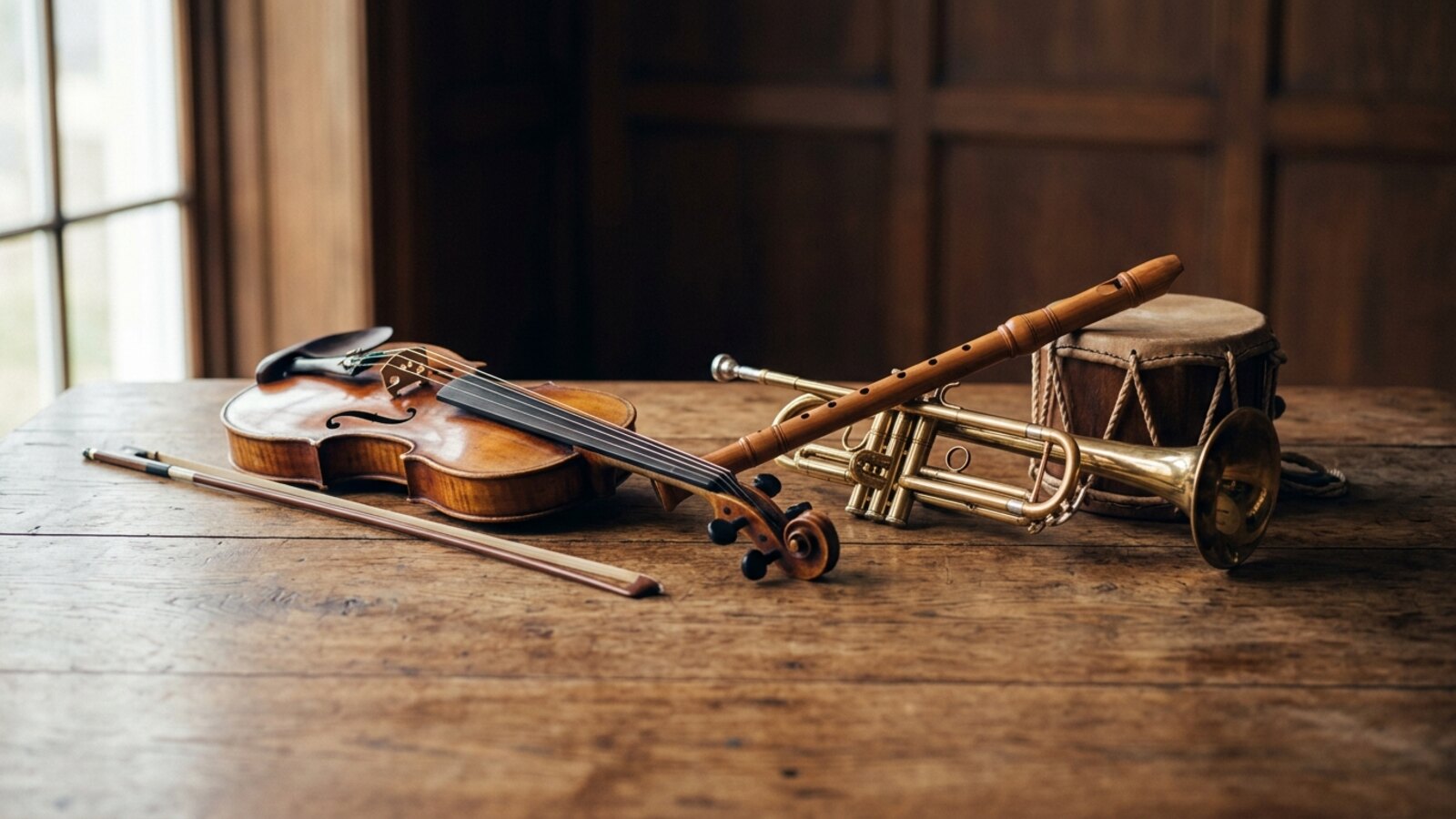
- A simple woodwind instrument with a whistle mouthpiece and finger holes, popular for early music and educational purposes.
Brass · 10
- Trumpet/ TRUM-pet /
- A brass instrument with a brilliant, penetrating tone, played by buzzing the lips into a cup-shaped mouthpiece and using valves to change pitch.
- Cornet/ KOR-net /
- A brass instrument similar to the trumpet but with a conical bore, producing a mellower, more rounded tone. Often used in brass bands.
- French Horn/ FRENCH HORN /
- A brass instrument with a coiled, conical tube and a wide, flaring bell, known for its warm, rich, and mellow tone.
- Tenor Trombone/ TEN-or TROM-bohn /
- A brass instrument played by moving a slide to change the length of the tubing, producing a powerful and versatile sound.
- Bass Trombone/ BAYS TROM-bohn /
- A larger, lower-pitched version of the trombone, often featuring an extra valve to extend its range into the bass register.
- Tuba/ TOO-buh /
- The largest and lowest-pitched brass instrument, providing the bass foundation for orchestras and bands with its deep, resonant sound.
- Euphonium/ yoo-FOH-nee-um /
- A conical-bore brass instrument similar to a small tuba, known for its rich, mellow, and vocal-like tone. Common in concert bands.
- Baritone Horn/ BAIR-ih-tohn HORN /
- A brass instrument similar to the euphonium but with a cylindrical bore, producing a brighter sound. Often used interchangeably with the euphonium.
- Flugelhorn/ FLOO-gul-horn /
- A valved brass instrument resembling a large cornet, with a wider, more conical bore, producing a very mellow and dark tone.
- Sousaphone/ SOO-zuh-fohn /
- A type of tuba designed to be worn around the player's body, primarily used in marching bands due to its portability and forward-facing bell.
Strings · 10
- Violin/ VY-uh-lin /
- The smallest and highest-pitched member of the string family, played with a bow or by plucking the strings. Essential to orchestras.
- Viola/ vee-OH-luh /
- A string instrument larger than the violin but smaller than the cello, playing in a lower register with a rich, mellow tone.
- Cello/ CHEL-oh /
- A large string instrument played while seated, held between the knees, known for its deep, resonant, and expressive tone.
- Double Bass/ DUH-bul BAYS /
- Also known as Contrabass, the largest and lowest-pitched member of the string family, providing the bass foundation in orchestral music.
- Harp/ HARP /
- A large string instrument with many strings stretched vertically across a frame, played by plucking the strings with the fingers.
- Classical Guitar/ KLAS-ih-kuhl gi-TAR /
- An acoustic string instrument with nylon strings, known for its warm tone and used for classical music, flamenco, and folk.
- Mandolin/ MAN-duh-lin /
- A small string instrument of the lute family, typically with eight strings in four courses, played with a pick.
- Banjo/ BAN-joh /
- A string instrument with a thin membrane stretched over a frame or cavity as a resonator, typically with four or five strings.
- Ukulele/ yoo-kuh-LAY-lee /
- A small, four-stringed Hawaiian string instrument, known for its light, cheerful sound.
- Lute/ LOOT /
- A string instrument with a deep, round back, a neck, and a pegbox, popular in European classical music from the medieval to late Baroque eras.
Percussion · 13
- Timpani/ TIM-puh-nee /
- Also known as kettledrums, large bowl-shaped drums with tunable heads, played with mallets. Essential in orchestral percussion.
- Snare Drum/ SNAIR DRUM /
- A drum with snares (strands of wire or gut) stretched across the bottom head, producing a sharp, rattling sound.
- Bass Drum/ BAYS DRUM /
- A large drum that produces a low, deep sound, often used to mark the beat or add dramatic emphasis.
- Cymbals/ SIM-buhlz /
- Percussion instruments consisting of thin, round metal plates, played by striking them together or with mallets.
- Triangle/ TRY-ang-gul /
- A percussion instrument made of a metal rod bent into a triangle shape, open at one corner, played by striking it with a metal beater.
- Tambourine/ TAM-buh-reen /
- A percussion instrument consisting of a frame, often wood or plastic, with pairs of small metal jingles, and sometimes a drumhead.
- Glockenspiel/ GLOK-un-speel /
- A percussion instrument consisting of a set of tuned metal bars, played with mallets, producing a bright, bell-like tone.
- Xylophone/ ZY-luh-fohn /
- A percussion instrument consisting of a set of tuned wooden bars arranged like a piano keyboard, played with mallets.
- Marimba/ muh-RIM-buh /
- A large percussion instrument similar to a xylophone but with wooden resonators, producing a rich, warm, and mellow tone.
- Vibraphone/ VY-bruh-fohn /
- A percussion instrument similar to a xylophone or marimba but with metal bars and motor-driven rotating discs below the bars, creating a vibrato effect.
- Tubular Bells/ TOO-byoo-ler BELZ /
- Also known as chimes, a percussion instrument consisting of a set of metal tubes of varying lengths, suspended vertically and struck with a hammer.
- Gong/ GONG /
- A large, flat, circular metal disc that is struck with a mallet, producing a deep, resonant, and often sustained sound.
- Wood Block/ WOOOD BLOK /
- A small, hollow block of wood, typically rectangular, struck with a mallet to produce a dry, percussive sound.
Keyboards · 5
- Piano/ pee-AN-oh /
- A keyboard instrument where hammers strike strings to produce sound, capable of a wide dynamic range and used in nearly all genres.
- Harpsichord/ HARP-sih-kord /
- A keyboard instrument where strings are plucked by quills when keys are pressed, popular in the Baroque era. It has a bright, twangy sound.
- Pipe Organ/ PYP OR-gun /
- A large musical instrument with one or more keyboards, played by sending pressurized air through pipes of varying sizes and shapes.
- Celesta/ suh-LES-tuh /
- A keyboard instrument resembling a small upright piano, but with metal plates struck by hammers, producing a delicate, bell-like tone.
- Synthesizer/ SIN-thuh-sy-zer /
- An electronic musical instrument that generates audio signals, allowing for the creation of a wide variety of sounds, from imitations of acoustic instruments to unique electronic timbres.
Pro
Study this set with Pro
All 50 cards with native audio and spaced repetition, plus every other language and subject on SubjectCards.
That is $3.33 a month, billed yearly.
Secure checkout by Stripe. Yearly plan starts with a free trial; cancel anytime.
- Every language and subject, all decks
- Native audio on every card
- Spaced-repetition study with progress tracking
- iPhone app Premium included: unlimited own-phrase cards and custom subjects
- Cancel anytime from your account
Frequently asked questions
Why is mastering musical instrument vocabulary important?
Understanding musical instrument vocabulary and playing techniques is fundamental for any music enthusiast. It enhances your ability to read scores, communicate effectively with other musicians, appreciate diverse musical genres, and excel in music theory exams. These flashcards provide the essential music terminology you need.
How do these flashcards cover playing techniques?
Our 'Musical Instruments Vocabulary and Techniques' flashcards define key playing techniques associated with various instruments, from pizzicato for strings to embouchure for woodwinds. This helps you not only identify instruments but also understand how they produce sound and are performed, deepening your musical knowledge.
Who can benefit most from this flashcard set?
This flashcard set is ideal for music students, aspiring musicians, music educators, and anyone passionate about deepening their understanding of orchestral instruments and general music terminology. Whether you're a beginner or looking to refine your knowledge, these flashcards are a valuable resource for music education.
Can these flashcards help me identify instruments by sound?
While primarily focused on visual and textual vocabulary, the detailed descriptions of each instrument and its characteristic sound within these flashcards will significantly aid your auditory recognition skills. By associating the name with its properties and techniques, you'll build a stronger mental connection for instrument identification.