Music Theory Flashcards
Ready-made music theory flashcards with a built-in spaced-repetition study system — the fundamentals and notation, chords and harmony, dynamic and articulation markings, and the instruments of the orchestra. Read every card free; one Pro plan opens study with audio on every set.
All Music flashcard sets
Pick the set that fits your goal. Read every card free; Pro unlocks study with native audio on all of them.
Music Theory Fundamentals - Essential Concepts
Master music theory fundamentals with flashcards covering scales, chords, intervals, and harmonic progressions for musicians and students.
Music Dynamics and Articulation - Performance Techniques
Learn music dynamics, articulation marks, and performance techniques. Essential for musicians to express musical interpretation effectively.
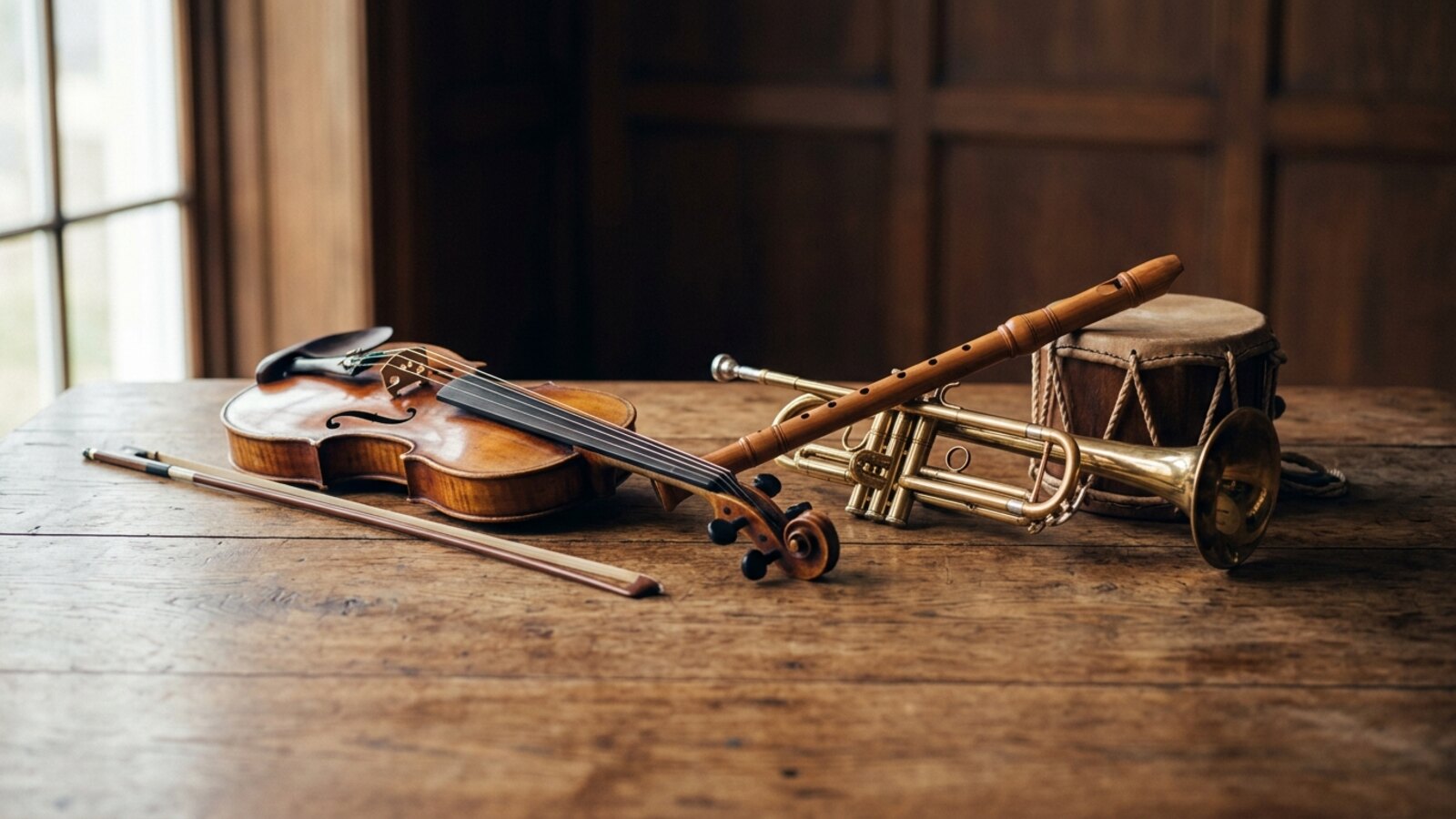
Musical Instruments Vocabulary and Techniques
Learn musical instruments, playing techniques, and performance terminology. Perfect for music students and aspiring musicians.
Which music theory set should you start with?
| You want to | Start with | Then | Why |
|---|---|---|---|
| Read sheet music and understand what you are playing | Music Theory Fundamentals | Music Dynamics and Articulation | Scales, intervals and chords are the grammar. Everything else is notation on top of them. |
| Play a piece the way it is marked | Music Dynamics and Articulation | Music Theory Fundamentals | Dynamics and articulation are the instructions most self-taught players skip, and the ones an examiner listens for. |
| Talk to other musicians without guessing | Musical Instruments Vocabulary | Music Theory Fundamentals | Ensemble and instrument terms are what rehearsal language is made of. |
| Prepare for a grade exam | Music Theory Fundamentals | Dynamics and Articulation, then Instruments | Graded syllabuses test notation and terms as recall, which is exactly what spaced repetition suits. |
The order theory actually makes sense in
Theory is easier learned in dependency order than in textbook order. Intervals come first, because an interval is just the distance between two notes and everything after it is built from that. Scales are patterns of intervals. Chords are notes stacked in intervals. Progressions are chords in sequence. Take them out of order and each one has to be memorised rather than understood.
Notation is the second layer and a different kind of knowledge. Key signatures, time signatures, note values and rests are conventions to recall on sight, with no reasoning to fall back on when recall fails. This is the part flashcards genuinely earn their place on, and the part that most rewards short daily review.
Dynamics and articulation are where theory becomes performance. Piano and forte set volume, crescendo and diminuendo change it over time, and staccato, legato and accent marks change how each note is attacked and released. Two players reading identical pitches and rhythms sound different almost entirely because of these marks.
Theory follows the ear rather than leading it. A term learned on a card is worth much more once you have heard the thing it names, so play or listen to each interval, chord quality and articulation as you learn its name. The audio on each card is there so the term and the sound arrive together instead of years apart.
Why these Music flashcards
Native-speaker audio
Hear the correct pronunciation on every card, not just a romanization.
No Anki, no setup
Study right here in your browser or on mobile. Nothing to install or configure.
One plan, every deck
Pro covers every language and subject here and in the iPhone app. Cancel anytime.
Preview the flashcards
A free sample drawn from across the Music sets — hear every card with native audio in the full deck.
- Whole Rest/ hohl rest /
- A rest indicating four beats of silence in common time (4/4 time signature). It hangs from the fourth line of the staff.
- Pianissimo (pp)/ pee-uh-NISS-ih-moh /
- Very soft. Indicates the quietest dynamic level.
- Flute/ FLOOT /
- A woodwind instrument, usually made of metal, played by blowing across an embouchure hole. It produces a clear, high-pitched sound.
- Dot (Dotted Note)/ dot /
- A dot placed after a note or rest increases its duration by half of its original value.
- Fortississimo (fff)/ for-tiss-ISS-ih-moh /
- Extremely loud. Even louder than fortissimo.
- Trumpet/ TRUM-pet /
- A brass instrument with a brilliant, penetrating tone, played by buzzing the lips into a cup-shaped mouthpiece and using valves to change pitch.
- Sforzando (sfz)/ sfor-TSAHN-doh /
- A dynamic marking indicating a sudden, strong accent on a single note or chord.
- Staccato/ stuh-KAH-toh /
- Short and detached; play the note sharply separated from the next.
- Double Bass/ DUH-bul BAYS /
- Also known as Contrabass, the largest and lowest-pitched member of the string family, providing the bass foundation in orchestral music.
- Fourth/ forth /
- The interval spanning four scale degrees (e.g., C to F). Often a perfect fourth.
- Con sordino/ kon sor-DEE-noh /
- With mute; instructs string players to use a mute, or brass players to insert a mute into their instrument's bell, to dampen the sound.
- Tambourine/ TAM-buh-reen /
- A percussion instrument consisting of a frame, often wood or plastic, with pairs of small metal jingles, and sometimes a drumhead.
Frequently asked questions
What is the fastest way to learn music theory?
Learn it in small topics — notes and notation, then intervals, then chords and progressions — and review with spaced repetition so each concept comes back right before you'd forget it. A few minutes a day is more effective than one long session, and applying each idea at your instrument makes it stick.
What do these music theory flashcards cover?
The sets span the fundamentals — pitch, rhythm, and notation, chord construction, and harmonic progressions — plus dynamic and articulation markings (forte, staccato, legato) and the vocabulary of orchestral instruments and their techniques.
Do these music theory flashcards include audio?
Yes. Every card can be played aloud so you can hear each Italian term and marking spoken correctly, and the built-in spaced-repetition system schedules your reviews. Everything runs in your browser and on mobile.
Do I need a subscription?
Reading every card is free and the study system runs right here, nothing to install. Study mode with audio is part of SubjectCards Pro, one plan that covers every subject on the site.
Keep learning Music
More free guides and decks to get you speaking.