Spanish Phrases for Ordering Food
32 flashcards · Beginner · Language Learning
Best forTravelers heading to Spain or Latin America who want to order in restaurants, bars and cafes in Spanish.
PriceFree to read. Pro is $6.99 a month or $39.99 a year, on the web and iPhone.
Part of Spanish Flashcards — compare every set side by side.
Try a sample flashcard
Flip it, then tap the speaker to hear the audio every card carries.
Una mesa para dos, por favor.
Click to flip
A table for two, please. You say this at the door. Change the number for your group: tres, cuatro, cinco. Used in Spain and Latin America.
Una mesa para dos, por favor.
What you'll learn
- How to ask for a table and call the server
- How to order coffee your way, from a cortado to an iced coffee
- How to order tapas, portions and the menu of the day
- How to ask about ingredients and say you have an allergy
- How to ask for the bill, pay and tip in Spain and Mexico
- What the server is likely to ask you at each step
What's inside: all 32 cards
Every card in this set, free to read. Pro adds audio on each one and a review schedule that brings it back before you forget it.
Ask for a Table · 2
- Una mesa para dos, por favor./ OO-nah MEH-sah PAH-rah dohs, por fah-BOR /
- A table for two, please. You say this at the door. Change the number for your group: tres, cuatro, cinco. Used in Spain and Latin America.
- ¿Dentro o en la terraza?/ DEN-troh oh en lah teh-RAH-thah (Spain); teh-RAH-sah (Latin America) /
- The host or server asks: Inside or on the terrace? Common in Spain. In Latin America you will more often hear ¿Adentro o afuera? (Inside or outside?).
Get the Server's Attention · 2
- Perdona./ pehr-DOH-nah /
- Excuse me. The everyday way to get a server's attention in Spain, where people usually use tú with staff. Say it with eye contact or a raised hand as they pass. The formal Perdone also works. Do not snap your fingers or whistle.
- Disculpa./ dees-KOOL-pah /
- Excuse me. Another everyday way to call a server. In much of Latin America the formal Disculpe is more common.
Order Drinks or Coffee · 7
- ¿Qué van a tomar?/ keh bahn ah toh-MAR /
- The server asks: What will you have? This is usually the first question, and it often means drinks. Used in Spain and Latin America. In Spain you may also hear ¿Qué os pongo?
- ¿Me pones un café con leche?/ meh POH-nehs oon kah-FEH kohn LEH-cheh /
- Can I have a coffee with milk? Spain. ¿Me pones...? is casual (tú) and completely normal at bars and cafes in Spain. In Latin America it can sound odd; use ¿Me da...? or Quisiera... instead.
- ¿Me da un café con leche, por favor?/ meh dah oon kah-FEH kohn LEH-cheh, por fah-BOR /
- Could you give me a coffee with milk, please? Polite (usted). A common way to order in Mexico and much of Latin America. It is also used in Spain.
- Un americano, por favor./ oon ah-meh-ree-KAH-noh, por fah-BOR /
- An americano, please. The quickest way to order a coffee. Quisiera un café americano (I would like an americano) is more formal and works everywhere.
- Un cortado, por favor./ oon kor-TAH-doh, por fah-BOR /
- A cortado, please: a small espresso with a splash of milk. A Spain staple. For a plain small black coffee, ask for un café solo in Spain or un expreso in many Latin American countries.
- Un café con hielo, por favor./ oon kah-FEH kohn YEH-loh, por fah-BOR /
- A coffee with ice, please. In Spain this usually brings a hot coffee plus a glass of ice, and you pour the coffee over the ice yourself. In Latin America, ask for un café frío for a ready-made iced coffee. In some countries, such as Chile, café helado comes with ice cream.
- ¿Para tomar aquí o para llevar?/ PAH-rah toh-MAR ah-KEE oh PAH-rah yeh-BAR /
- The server asks: For here or to go? Common in Spain. In Mexico you will often hear ¿Para comer aquí o para llevar? Answer Para tomar aquí (for here) or Para llevar (to go).
Order Food or Tapas · 5
- ¿Qué me recomiendas?/ keh meh reh-koh-MYEN-dahs /
- What do you recommend? Said to the server, tú form, usual in Spain. The formal ¿Qué me recomienda? is more common in Latin America.
- Para mí, el menú del día./ PAH-rah mee, el meh-NOO del DEE-ah /
- For me, the set menu of the day. In Spain the menú del día is a fixed-price lunch with a starter, a main, bread, a drink, and dessert or coffee. In Mexico the similar lunch is often called comida corrida.
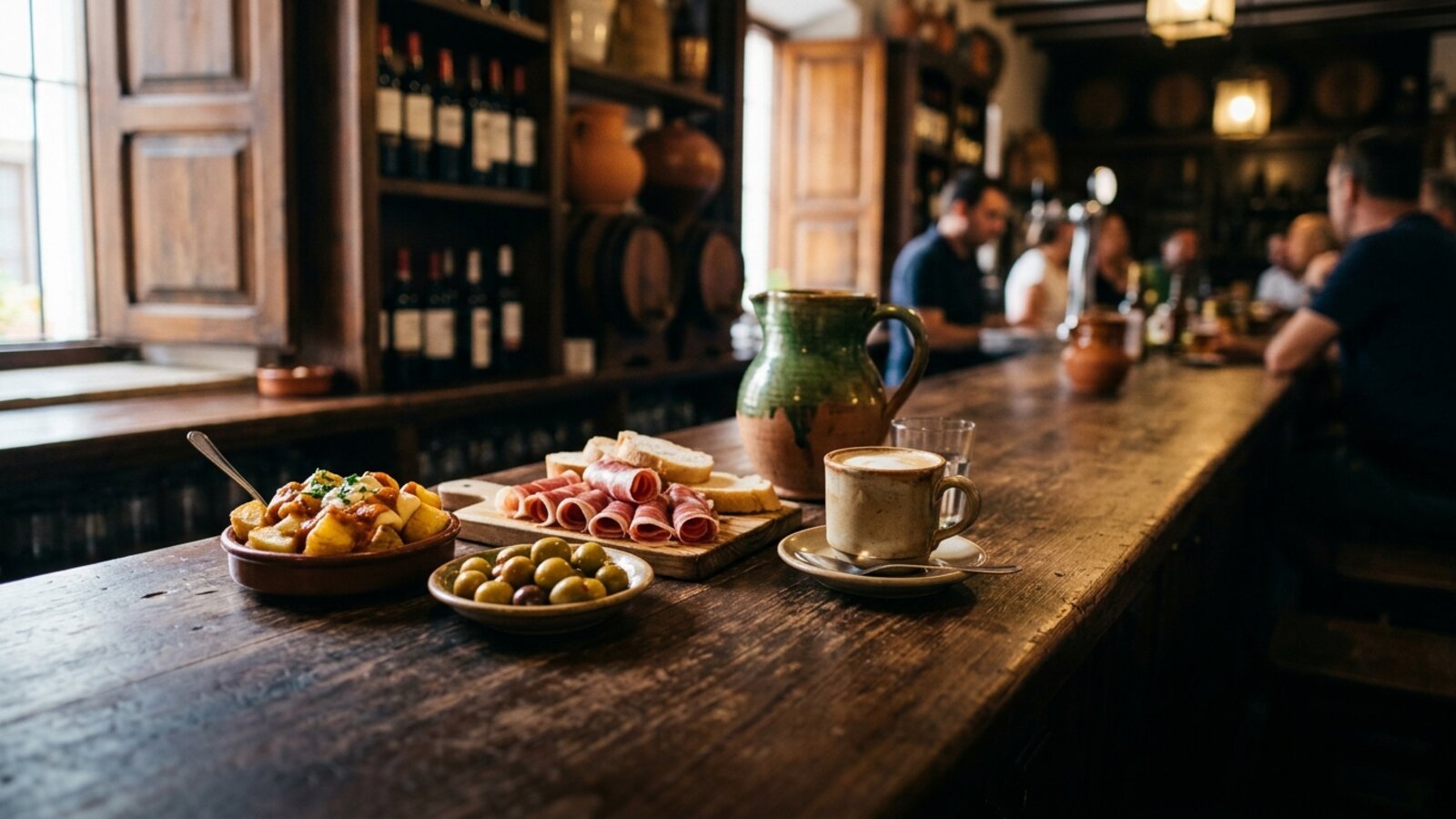
- Una ración de patatas bravas para compartir./ OO-nah rah-THYOHN deh pah-TAH-tahs BRAH-bahs PAH-rah kohm-par-TEER (Spain) /
- A portion of patatas bravas (fried potatoes with spicy sauce) to share. Spain. A tapa is a small plate, a media ración is a half portion, and a ración is a full plate for sharing. In Latin America potatoes are papas, not patatas.
- ¿Algo más?/ AHL-goh mahs /
- The server asks: Anything else? Used in Spain and Latin America.
- Nada más, gracias./ NAH-dah mahs, GRAH-thyahs (Spain); GRAH-syahs (Latin America) /
- That's all, thanks. Your answer to ¿Algo más? Eso es todo, gracias means the same and is common in Latin America.
Ask About a Dish or an Allergy · 6
- ¿Qué lleva este plato?/ keh YEH-bah ES-teh PLAH-toh /
- What is in this dish? Common in Spain. In Latin America you will also hear ¿Qué tiene este plato?
- Tengo alergia al marisco./ TEN-goh ah-LEHR-hyah ahl mah-REES-koh /
- I'm allergic to shellfish. The same words for anyone, with no gender ending. Soy alérgico (or alérgica) al marisco also works. In Latin America you will also hear los mariscos.
- Tengo alergia a los cacahuetes./ TEN-goh ah-LEHR-hyah ah lohs kah-kah-WEH-tehs /
- I have a peanut allergy. This form is the same for men and women. Peanuts are cacahuetes in Spain, cacahuates in Mexico, and maní in much of South America.
- ¿Lleva gluten?/ YEH-bah GLOO-ten /
- Does it contain gluten? Used in Spain and Latin America. Sin gluten means gluten-free.
- No, no lleva nada./ noh, noh YEH-bah NAH-dah /
- The server answers: No, it doesn't have any. A reply to a question like ¿Lleva gluten? Sí, lleva means yes, it does.
- Voy a preguntar en la cocina./ boy ah preh-goon-TAR en lah koh-THEE-nah (Spain); koh-SEE-nah (Latin America) /
- The server says: I'll ask in the kitchen. A common reply when they are not sure what a dish contains. Used in Spain and Latin America.
Change the Order · 4
- ¿Me lo puede traer sin cebolla?/ meh loh PWEH-deh trah-EHR seen theh-BOH-yah (Spain); seh-BOH-yah (Latin America) /
- Could you bring it without onion? Polite (usted). Swap cebolla for any ingredient: sin queso (without cheese), sin ajo (without garlic). Used in Spain and Latin America.
- ¿Nos trae más pan, por favor?/ nohs TRAH-eh mahs pahn, por fah-BOR /
- Could you bring us more bread, please? Polite (usted). Used in Spain and Latin America. In Spain bread may be added to the bill.
- ¿Me trae una servilleta, por favor?/ meh TRAH-eh OO-nah sehr-bee-YEH-tah, por fah-BOR /
- Could you bring me a napkin, please? Polite (usted). Used in Spain and Latin America.
- Más agua, por favor./ mahs AH-gwah, por fah-BOR /
- More water, please. In Spain you can ask for agua del grifo (tap water). In much of Latin America people usually order bottled water instead: agua embotellada.
Ask for the Bill · 3
- La cuenta, por favor./ lah KWEN-tah, por fah-BOR /
- The bill, please. In Spain the server usually waits for you to ask, so asking is normal and not rude. Lingering at the table after the meal is common. The same phrase works in Latin America.
- ¿Podemos pagar por separado?/ poh-DEH-mohs pah-GAR por seh-pah-RAH-doh /
- Can we pay separately? Used in Spain and Latin America. Some places prefer one bill per table, so ask before you order if it matters.
- ¿Efectivo o tarjeta?/ eh-fek-TEE-boh oh tar-HEH-tah /
- The server asks: Cash or card? Used in Spain and Latin America. Answer En efectivo (cash) or Con tarjeta (card).
Pay and Leave · 3
- ¿Está incluida la propina?/ es-TAH een-kloo-EE-dah lah proh-PEE-nah /
- Is the tip included? In Spain, tipping is optional and small; people often round up or leave some change. In Mexico, about 10 to 15 percent is customary at sit-down restaurants and is usually not included, though some bills add it as servicio.
- Quédate con el cambio./ KEH-dah-teh kohn el KAHM-byoh /
- Keep the change. Tú form, said to the server as you pay in cash. Formal: Quédese con el cambio. In Spain you will also hear con la vuelta.
- Estaba todo buenísimo./ es-TAH-bah TOH-doh bweh-NEE-see-moh /
- Everything was delicious. Say it to the server as they clear the plates or as you leave. Estaba todo riquísimo means the same. Used in Spain and Latin America.
Pro
Study this set with Pro
All 32 cards with audio and spaced repetition, plus every other language and subject on SubjectCards.
That is $3.33 a month, billed yearly.
Secure checkout by Stripe. Yearly plan starts with a free trial; cancel anytime.
- Every language and subject, all decks
- Text-to-speech audio on every card
- Spaced-repetition study with progress tracking
- iPhone app Premium included: unlimited own-phrase cards and custom subjects
- Cancel anytime from your account