Korean Phrases for Ordering Food and BBQ
32 flashcards · Beginner · Language Learning
Best forTravelers and beginners who want to order at Korean restaurants, Korean BBQ and cafes in Korea.
PriceFree to read. Pro is $6.99 a month or $39.99 a year, on the web and iPhone.
Part of Korean Flashcards — compare every set side by side.
Try a sample flashcard
Flip it, then tap the speaker to hear the audio every card carries.
몇 분이세요?
Click to flip
How many people? Staff ask this as you walk in. Answer with the number and 명이요.
몇 분이세요?
What you'll learn
- How to call staff in a busy Korean restaurant
- How to order dishes and Korean BBQ by the portion
- What the two-portion minimum at BBQ places means
- How to ask for refills, a new grill plate and help with the meat
- How to pay, split the bill and say thank you
- How to order hot, iced and to-go drinks at a cafe
What's inside: all 32 cards
Every card in this set, free to read. Pro adds audio on each one and a review schedule that brings it back before you forget it.
Enter and say how many · 4
- 몇 분이세요?/ myeot buniseyo /
- How many people? Staff ask this as you walk in. Answer with the number and 명이요.
- 두 명이요./ du myeong-iyo /
- Two people. Swap the number: 한 명이요 (one), 세 명이요 (three), 네 명이요 (four). Use the pure Korean numbers here.
- 아무 데나 앉으세요./ amu dena anjeuseyo /
- Sit anywhere you like. Staff say this when there is no host seating you.
- 기다리시겠어요?/ gidarisigesseoyo /
- Would you like to wait? Staff ask this when the restaurant is full. Busy places may also ask for your name and phone number, or have you sign up on a tablet by the door.
Call the staff · 3
- 여기요./ yeogiyo /
- Excuse me, over here. The most common way to call staff in Korea. Say it out loud and raise your hand. Calling out is normal and polite here. Some tables have a call button instead.
- 저기요./ jeogiyo /
- Excuse me. Also calls staff, and also gets a stranger's attention on the street. Works anywhere 여기요 does.
- 이모/ imo /
- Auntie. Koreans often call a middle-aged woman working at a casual or traditional restaurant 이모 to sound warm and friendly. It fits that kind of place and that kind of server. With young staff or in an upscale restaurant it would sound odd. If unsure, 여기요 is the safe choice.
Order · 6
- 메뉴판 좀 주세요./ menyupan jom juseyo /
- The menu, please. 좀 (a little) softens the request. Many places post the menu on the wall instead, so look around first.
- 이거 주세요./ igeo juseyo /
- This one, please. Point at the menu or a picture as you say it. The easiest way to order anything.
- 김치찌개 하나 주세요./ gimchijjigae hana juseyo /
- One kimchi stew, please. The pattern is dish, then number, then 주세요 (please give me). Use pure Korean numbers: 하나 (one), 둘 (two), 셋 (three).
- 여기 뭐가 제일 맛있어요?/ yeogi mwoga jeil masisseoyo /
- What's best here? Literally 'what is the most delicious here'. The usual way to ask what is popular or what staff recommend.
- 이거 매워요?/ igeo maewoyo /
- Is this spicy? Point at the dish on the menu.
- 덜 맵게 해 주세요./ deol maepge hae juseyo /
- Please make it less spicy. Not every dish can be changed, since many sauces are made ahead.
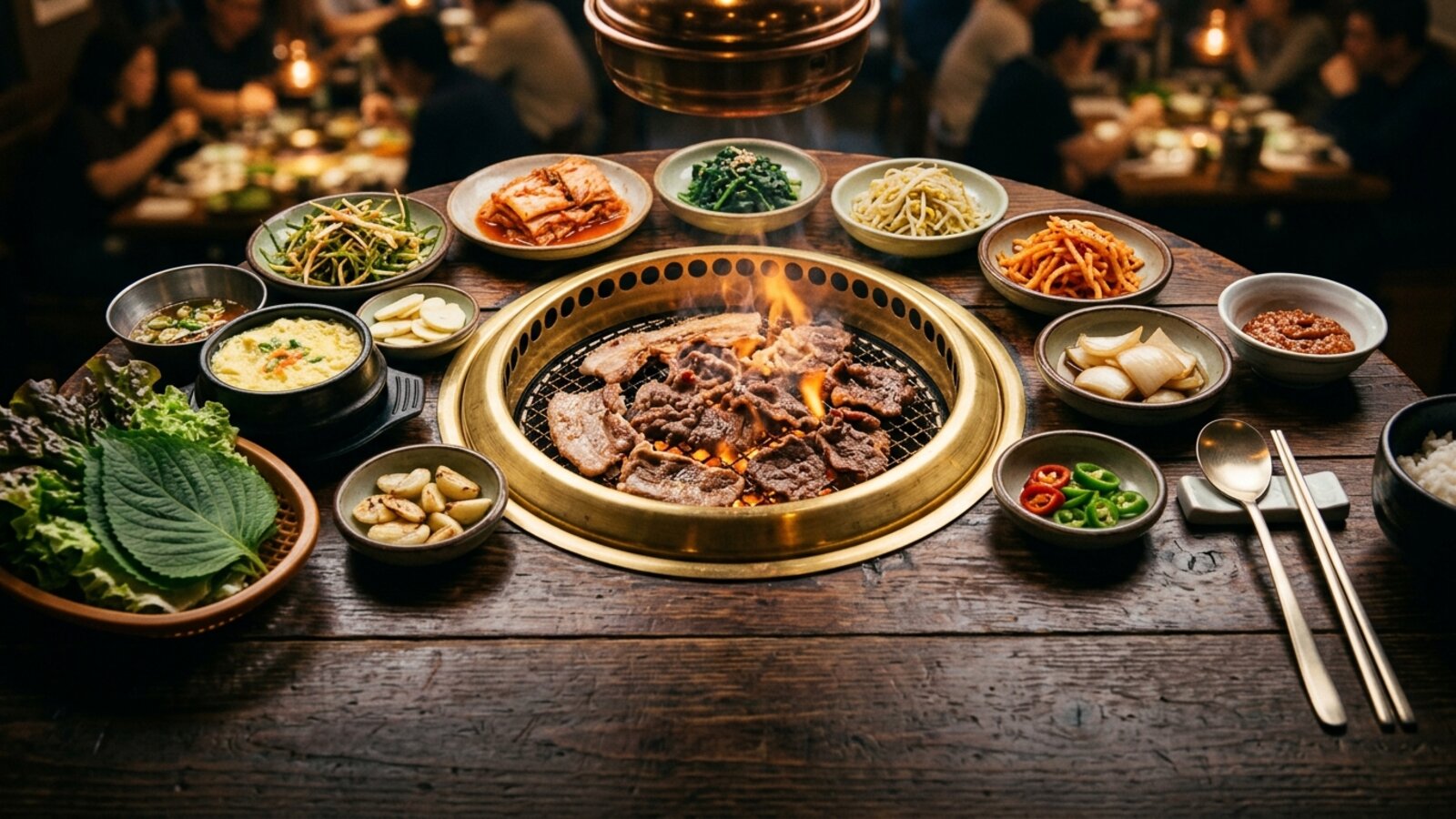
BBQ portions and the 2-portion minimum · 3
- 삼겹살 2인분 주세요./ samgyeopsal i-inbun juseyo /
- Two portions of pork belly, please. BBQ meat is ordered by portion (인분), read with Sino-Korean numbers: 2인분 is said i-inbun, 3인분 sam-inbun.
- 이 인분부터 주문 가능해요./ i inbunbuteo jumun ganeunghaeyo /
- You can order from two portions. You may hear this, or see it on the menu, at many BBQ places. It means the first order must be at least two portions. It varies by restaurant. Some take one portion, and some do not seat solo diners for BBQ.
- 목살 일 인분 추가해 주세요./ moksal il inbun chugahae juseyo /
- Please add one more portion of pork neck. Use 추가 (add) to order more meat partway through. Many places that have a two-portion minimum still let you add one portion at a time after the first order.
Refills and side dishes · 5
- 반찬 좀 더 주세요./ banchan jom deo juseyo /
- More side dishes, please. Side dishes (banchan) are refilled for free at most restaurants. Some places have a self-serve bar instead, marked 셀프 (self).
- 상추 좀 더 주세요./ sangchu jom deo juseyo /
- More lettuce, please. Lettuce for wrapping BBQ meat is usually refilled for free. Some places charge for extra or have you help yourself.
- 물 좀 주세요./ mul jom juseyo /
- Some water, please. Water is free. At many places it is self-serve, and you may see a sign that says 물은 셀프 (water is self-serve).
- 소주 한 병 주세요./ soju han byeong juseyo /
- One bottle of soju, please. Bottles take pure Korean numbers: 한 병 (one bottle), 두 병 (two bottles). Swap in 맥주 (beer) or 콜라 (cola).
- 입에 맞으세요?/ ibe majeuseyo /
- Is the food to your liking? Literally 'does it suit your mouth'. An owner or server may ask this, much like 'Is everything okay?' Answer 네, 맛있어요 (yes, it's delicious).
Grill and cooking help · 3
- 불판 좀 갈아 주세요./ bulpan jom gara juseyo /
- Please change the grill plate. Ask when the grill gets black or sticky. Staff usually swap it for free.
- 고기 좀 구워 주세요./ gogi jom guwo juseyo /
- Please grill the meat for us. At many places, especially beef restaurants, staff grill and cut the meat for you. At cheaper self-grill places they may help only when it is not busy.
- 가위 좀 주세요./ gawi jom juseyo /
- Scissors, please. Korean restaurants often cut meat, kimchi and cold noodles with kitchen scissors at the table.
Pay · 3
- 계산해 주세요./ gyesanhae juseyo /
- The bill, please. At most restaurants you pay at the counter by the door, so you can also just walk up with your table number or receipt.
- 따로 계산해도 돼요?/ ttaro gyesanhaedo dwaeyo /
- Can we pay separately? Many places accept it, but some busy restaurants prefer one payment per table.
- 카드세요, 현금이세요?/ kadeuseyo, hyeongeumiseyo /
- Card or cash? A cashier may ask this. Cards are accepted almost everywhere in Korea, so often they just take your card. Answer 카드요 (card) or 현금이요 (cash).
Leave · 1
- 잘 먹었습니다./ jal meogeotseumnida /
- Thank you for the meal. Literally 'I ate well'. Say it to the staff or owner as you pay or walk out. It is polite and warmly received.
Order at a cafe · 4
- 아이스 아메리카노 한 잔 주세요./ aiseu amerikano han jan juseyo /
- One iced americano, please. Drinks take 잔 (cup) with pure Korean numbers: 한 잔 (one), 두 잔 (two). 아이스 (iced) goes before drinks that come hot or cold, like coffee and tea. You will also hear 아메리카노 아이스로.
- 따뜻한 라떼 한 잔 주세요./ ttatteutan ratte han jan juseyo /
- One hot latte, please. 따뜻한 means hot or warm. Staff may ask 따뜻한 거요, 아이스요? (hot or iced?).
- 드시고 가세요?/ deusigo gaseyo /
- For here? Literally 'will you eat or drink and then go'. Cafe staff ask this after you order. Answer 먹고 갈게요 (for here) or 테이크아웃이요 (to go).
- 포장해 주세요./ pojanghae juseyo /
- Please pack it to go. Works for food and drinks. At cafes, 테이크아웃이요 (takeout) is also common.
Pro
Study this set with Pro
All 32 cards with audio and spaced repetition, plus every other language and subject on SubjectCards.
That is $3.33 a month, billed yearly.
Secure checkout by Stripe. Yearly plan starts with a free trial; cancel anytime.
- Every language and subject, all decks
- Text-to-speech audio on every card
- Spaced-repetition study with progress tracking
- iPhone app Premium included: unlimited own-phrase cards and custom subjects
- Cancel anytime from your account